MIDI Designer Spotted in Berlin: Electro Band!

Electro Band

Video reviews aside, this is one of the most professional videos of MIDI Designer that I’ve seen. First, who is Electro Band? Here’s a description of the band’s Facebook blurb translated to English. But make sure to check out their interesting, interactive website.

When the violin hits in this video (at about 0:33) you’ll understand just how awesome it is. While I’m glad that it’s a pro video using MIDI Designer, I’m even happier that it’s really fun to watch and listen to. The video:


http://youtu.be/v8_tNoowlWs

Is That Really MIDI Designer?

So, the views of the iPad in the video are pretty quick, to say the least. It does look like MIDI Designer Pro (or Lite unlocked, which is Pro), but I wanted to see the layout. Glad I asked! Here’s a beautiful photo of the setup. Note the presence of the Korg KP3 Effects Sampler, which I’ve been in love with since about 2007. It’s not that unlikely a coincidence, but it’s still a very cool coincidence.

Thank you Electro Band for chosing to use MIDI Designer your setup, and huge congratulations on this fun video!

MIDI Designer is the go-to professional MIDI controller platform for iOS. Electro Band fuses technology and art.

Hardware Connections and New Lightning Connector

I’ve been asked by several users what options are available for the iPad mini, iPod touch 5G and iPhone 5 to connect via hardware (both to traditional MIDI targets and directly to a computer).

I consulted with iConnectivity and Line 6, both of whom said that either of these two adapters should work:

Lightning to 30-Pin Adapter [at Apple.com here] for $30

Lightning to 30-Pin Adapter

Lightning to 30-Pin Adapter [at Apple.com here] for $40

Lightning to 30-Pin Adapter

Test With Line 6 MIDI Mobilizer II: Passed

Test With IK Multimedia iRig MIDI: Passed

I’m still working on this and will update this post as new information becomes available.

Conclusion

You can use your legacy MIDI hardware with the Lightning connector with the standard adapter, and this applies to the iPod touch 5G, iPhone 5, iPad mini and iPad 4th generation. This is all great news (except for the money part). As always, if you have comment, questions, or any other feedback, please get in touch via the contact page.

Why Do I Need an Extra Control for Button Groups?

A user asked me today

Another thing came to my mind: some kind of “exclusive” toggle mode for multiple buttons would also be nice. Maybe I have overseen such a feature, but I noticed it while I was creating the buttons for the different waveforms for the Oscillators. Currently I have to turn every button of when I want to activate another.

To which I replied

Google button groups in midi designer. I’ll help if you need of course. Thanks!!!

Sent from my iPhone

Which no doubt led the user to the blog entry on button groups.

Then the user asked the question that I would’ve asked:

That’s the feature I tried to describe :). But why do I need an extra knob or slider for it?

And here’s my answer:

It’s a great question. The short answer is “just because” but the long answer has to do with integrity and with not being able to guess how users are going to use things. The button-groups feature works through a super-knob so it gives you all kinds of flexibility (none of which I predicted). For instance, you could have a super of THAT knob that jumps through the entire range, or a button “stepper” that steps you through the super. You could even have the super (or another super) be controlled by the accelerometer!

The other part of the answer is for efficiency: by doing it in this way I avoid adding additional UI elements in design mode. There’s no mention in the UI of button groups and almost none of steppers. Yet people are using these features in their rigs without problems. You can move the clutter to your pedalboards by sliding the pages up, if you like, or put them on a different page.

What about multiple MIDI messages? That’s a huge hassle right now.

One thing that will get included as a first-level feature is multiple MIDI messages. Right now it’s a huge hassle to do that using super- and subcontrols. In fact, there will be a lot of reworking in the near future to handle a lot of user pain points around the issue of programming multiple MIDI messages. Some of these features will also add functionality.

User response:

Your tip with moving the super controls to a separate page is perfect. Thanks for the advice.

I like your attitude! It is clear to see that you are sure about your product and take customers seriously. Keep up the good work!

<<blush>> and many thanks!

MIDI Designer 1.4.0 Launches

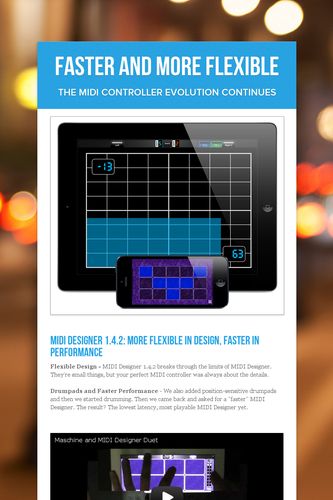
MIDI Designer Pro and Lite 1.4.01 for iPad and iPhone has been released. Read all about it in the flyer.


Are the Lite unlocks equivalent to Pro?

Pro is unlocked for iPad, iPhone and iPod touch as soon as you purchase it.

Lite requires you to in-app purchase (IAP) to unlock for iPad, and a separate IAP to unlock for iPhone. Lite, once unlocked, has the exact same functionality as Pro.


Note to MIDI Designer Pro Users: Thanks for your patience in the day and a half it took to work out the kinks in the 1.4.0 release. 1.4.01 is everything we promised (and more).

Growing Pains in 1.4.0 Release

Update Oct 30 7:44pm EDT: All problems resolved, 1.4.01 is live in the App Store for both Lite and Pro!!!

1.4.0 has been released as announced here. It brings a lot of new features and fixes to MIDI Designer Pro and Lite, and two completely new concepts:

  • In-app purchase in Lite to unlock for full colors and unlimited controls (separate unlocks for iPad and iPhone). Once unlocked, Lite is equivalent to Pro.
  • Universal app for all devices (iPad, iPhone, and iPod touch)

In bringing these two concepts to MIDI Designer on the App Store, two problems were discovered in 1.4.0 after launch. This is a worst-case scenario for MIDI Designer, and we’ve acted as quickly as possible to resolve these issues. They are both now resolved in 1.4.01, but this release must now complete the App Store review process (which we’re hoping to expedite has been granted an expedited review for Pro).

Update Oct 30 7:44pm EDT: All problems resolved, 1.4.01 is live in the App Store for both Lite and Pro!!!

MIDI Designer Pro problems in 1.4.0

The Pro version for iPad (only) has a launching problem, which does not result in a crash but is a critical bug nonetheless for more than 90% of users.

The Pro version 1.4.01 fixes the problem. It has been submitted for granted an expedited review, which could be resolved in as little as three days.

For the time being, MIDI Designer Pro 1.4.0 been removed from the App Store.

Update Oct 30 10:00am: We are grateful to Apple for granting an expedited review! Shouldn’t be long now.

Update Oct 30 7:44pm EDT: All problems resolved, 1.4.01 is live in the App Store!

MIDI Designer Lite Problems in 1.4.0

Update Oct 30 19:32pm EDT: All problems with Lite have been resolved with the MIDI Designer 1.4.01 update, now available in the App Store.

The Lite version for iPad and iPhone allows for an unlock via in-app purchase. If the user tries to add more than 5 or 12 controls on iPhone or iPad respectively, the app offers an unlock for the current device. The unlock does give unlimited controls. Due to a bug, however, it does not unlock the remaining colors. The correct behavior is that the Lite version unlocked should be equal to the Pro version in all regards.

The Lite version 1.4.01 fixes the problem with the color unlock. This has been submitted for normal review and users will not get all background colors until seven to nine days have elapsed.

For the time being, MIDI Designer Lite 1.4.0 remains in the App Store. Users who use in-app purchase for the unlock will get the remaining 136 colors when 1.4.01 drops.

Note

We’re sorry for the inconvenience caused by these two defects, and have worked directly with all the affected users that we have been made aware of to get them up and running again. If you are affected by the Pro upgrade and are unable to make your music, please get in touch via the contact page. To all of our users, present and future, thank you for your patience and great feeedback.

Update Oct 30 7:44pm EDT: Thank you Apple for the expedited review, and our users most of all for your patience during this 40-hour mini-crisis in music-making!

MIDI Designer Lite 1.4.0 is Out

MIDI Designer Lite 1.4.0 for iPad and iPhone has been released. Read all about it in the flyer.


Note to MIDI Designer Pro Users: MIDI Designer Pro has been temporarily removed from the App Store for a bug fix. A fixed version has been submitted for expedited review and should be out in 3-10 days (depending on the kindness of the Apple Review Committee). We apologize for the delay. If you have updated and are having problems with 1.4.0, please contact us and we’ll help you roll back.

Crossfader Overlap

Note: In 1.5.0 and greater, this is under Relationships -> Subcontrol Options.

Crossfader Overlap is an extension of “crossfader pieces,” which has been a feature of MIDI Designer since version 1.0. You can see that in this video, which is how I fade to a speech track and back:

So the basic idea is that one knob gets spun up to its max, and at the midpoint, another knob starts dropping.

In the past, you set this up by setting each subcontrol be a “crossfader piece,” one of which is also “inverted.” This gives you a linear crossover at 50% of the range of the supercontrol.

For our lighting users, this wasn’t enough, and they asked for crossfader overlap. It’s all linear still (for now), but it gives you some options. Now you can set the overlap to anything from .25 to 1.0. This produces a crossfade that looks like this. Note: Your old crossfader pieces will be changed to .5, which is the standard crossfader overlap.

Setup is almost identical: where “crossfader piece” was located, now there’s “crossfader overlap”:

Here’s an advanced use of crossfaders:

Advanced Use of Crossfader Overlap with 4 Mics on a Field

But the takeaway is always the same: if you want it, you’ve got more flexibility and power for your rig.

MIDI Designer 1.3.8, Virtual MIDI and iOS 6.0

November 1, 2012: This is no longer an issue and was fixed shortly after.

Yesterday I announced on Facebook and Twitter:

This is an overstatement. It’s actually not all of Virtual MIDI that’s broken in iOS 6 and MIDI Designer. This refers only to the Virtual MIDI ports that MIDI Designer creates, which are these two:

The reason for the break is that Apple made changes for iOS 6.0 to CoreMIDI. These are outlined in the iOS 6.0 Release Notes document. To be fair, the MIDI Designer development team should have fixed this before iOS 6.0 was officially released last week, but the ball was dropped as the team is focusing all of its attention on the iPhone version (getting very close).

So what’s the takeaway? Two points:

  1. You’re probably not affected. Most of the users that we’ve spoken with do not use MIDI Designer initiated virtual MIDI, but rather rely on the synth (or whatever) they’re talking to to provide the virtual ports.
  2. We’ve patched MIDI Designer 1.3.8 and have submitted it to the App Store.

If you are a MIDI Designer Pro user and absolutely cannot wait twelve days for the app to get approved, please get in touch with me ASAP and we’ll find a workaround.

November 1, 2012: This is no longer an issue and was fixed shortly after.